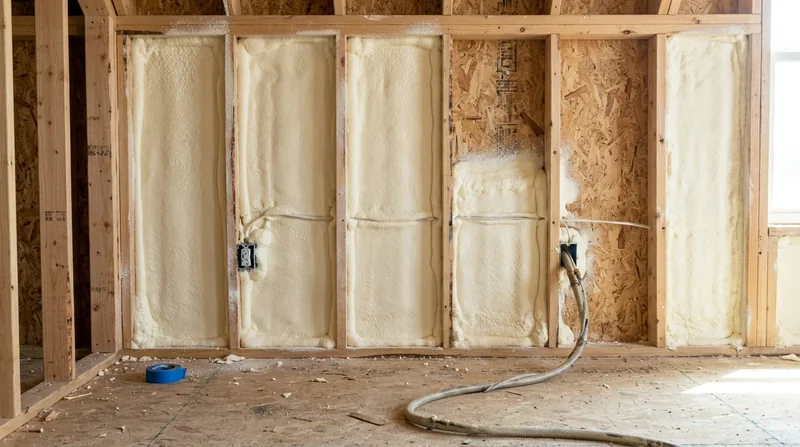




Open cell spray foam insulation in Waco fills the stud cavities and attic spaces of two-story subdivision homes across Woodway, Hewitt, Robinson and China Spring, sealing the gaps where humid outside air leaks inward through can lights, junction boxes and top plates. Waco's vented attics bake all summer along the Brazos River, and that heat riding straight through ductwork is what drives cooling bills higher than homeowners expect across McLennan County. Open cell foam expands to fill those voids and softens noise in bonus rooms, making it the right choice when your budget is tighter than closed cell but your air sealing need is real. We have been doing this work since 2011, and we know which jobs call for open cell, which call for closed cell, and which should get blown-in fiberglass instead. This page explains how open cell works in Waco's climate, what it costs, and how to find a contractor you can trust.
Why Open Cell Spray Foam Matters in Waco's Two-Story Homes
Newer subdivisions pushing out toward Woodway, Hewitt, Robinson and China Spring bring two-story construction with vented attics, bonus rooms over garages, and long duct runs exposed to attic heat. The problem is not just temperature, it is humidity. In Waco's climate zone 2A, humid outside air gets pulled inward through every gap in the top plate and every can light fixture, then condenses on cool ductwork and drips into insulation below. Open cell foam expands to seal those leaks, and because it is permeable, any moisture that does get in can dry back out. It also cuts noise transmission between floors and from outside, which matters when a bonus room sits directly over a garage or when a bedroom is on the second story above a vented attic.
- Expands to fill stud cavities and seal gaps around electrical boxes, can lights and top plates without requiring demolition.
- Reduces air infiltration in vented attics where humid outside air is pulled inward by the stack effect and cooling load.
- Permits moisture vapor to move through the foam, so condensation does not trap inside the cavity.
- Dampens sound transmission between floors and from exterior walls, improving comfort in bonus rooms and upstairs bedrooms.
- Costs less than closed cell foam and more than blown-in fiberglass, making it the middle option when budget and air sealing both matter.
These advantages add up when the job is a two-story home in Bellmead or Lacy-Lakeview where the attic heat load is real and the homeowner wants to seal leaks without paying closed cell prices.
Key info: Open cell foam is installed at roughly 0.5 to 1.0 pounds per cubic foot, giving it an R-value of 3.5 to 4.2 per inch. A 5.5-inch cavity in a stud wall or rafter bay gets you R-19 to R-23, enough to meet code in most Waco jobs, with the added benefit of air sealing that fiberglass alone cannot deliver.
For more detail on how spray foam insulation works across different applications in Waco, see our page on attic spray foam insulation, which covers sealed and vented attics, and our guide to air sealing, which explains the moisture and infiltration issues that foam solves.
How We Install Open Cell Spray Foam in Waco: Step by Step
The job starts with a walk-through to understand your attic or wall cavity, check for moisture, leaks or contamination, and measure the space we are filling. We will not spray over a wet substrate, standing water, or a roof that is actively leaking. If we find those conditions, we tell you straight and refer you to the right specialist. Once the space is dry and ready, we set up mechanical ventilation to move fumes out during cure, lay drop cloths to protect floors and belongings, and mask off areas that should not get foam. The actual spray takes hours depending on square footage, and the foam cures over twenty-four to forty-eight hours before the space is fully re-entered.
- Schedule a free estimate and walk the space with you to confirm open cell is the right choice and understand your goals.
- Inspect for moisture, leaks, contamination or pest damage and address any issues before we bring equipment on site.
- Set up mechanical ventilation and protective barriers to isolate the work area and manage fumes during application.
- Apply open cell foam at the manufacturer ratio and temperature, building thickness in multiple passes to avoid sag and ensure even density.
- Allow twenty-four to forty-eight hours cure time before normal occupancy, with mechanical ventilation running throughout.
- Trim excess foam flush with framing and install any required thermal or ignition barriers per local code.
This careful sequence is what separates a good foam job from a bad one. A fast spray with no ventilation, immediate re-entry promised, and a price far below market are the red flags of a rig-and-run crew that will leave you with smell, off-gassing and no one to call when things go wrong.
Real example: A two-story home in China Spring with a bonus room over the garage had ductwork running through an unconditioned attic space. Cool air was leaking out of the ducts, and humid outside air was leaking in through the top plate and can lights. We sealed the cavity around the ducts and the entire top plate with 5.5 inches of open cell foam, then installed a 15-minute thermal barrier as required by code. The result was tighter ducts, less humidity in the bonus room, and a quieter space.
For more detail on how we handle other spaces, see our pages on crawl space spray foam insulation and wall and injection foam insulation.
Open Cell Spray Foam Insulation Methods and Applications in Waco
| Method | Description | Best for |
|---|---|---|
| Cavity fill in stud walls | Open cell foam sprayed into 3.5-inch or 5.5-inch wall cavities during construction or retrofit without demolition. | New construction, remodels, and pre-1980 wall retrofits where exterior siding stays in place. |
| Attic rafter bays and top plate sealing | Foam sprayed into the space between roof rafters and along the top plate to seal air leaks and reduce infiltration. | Vented attics in two-story homes where ductwork runs through unconditioned space and humidity is a problem. |
| Bonus room and cathedral ceiling fill | Open cell foam in sloped ceilings and cathedral spaces to provide R-value and sound dampening between the conditioned room and the attic above. | Bonus rooms over garages and cathedral ceilings in Woodway and Robinson subdivisions where noise control matters. |
| Garage wall and ceiling fill | Foam applied to garage walls and ceilings to improve insulation and reduce sound transmission into living spaces. | Attached garages where a bedroom or living room is directly above or adjacent and sound and temperature isolation both matter. |
| Retrofit insulation in rim and band joists | Open cell foam sprayed into the rim joist band on older homes to seal the gap between the sill plate and the subfloor above. | Pier-and-beam homes in downtown Waco and near Baylor where vented crawl spaces allow air and humidity to move straight up into living rooms. |
Open Cell Spray Foam Insulation Cost in Waco: What to Expect
Open cell spray foam typically costs between $0.55 and $0.75 per board foot, depending on the complexity of the job, access to the space, and the amount of prep work needed. A board foot is the standard measure for spray foam: one foot long, one foot wide, and one inch thick. A typical 1,500-square-foot attic with 5.5-inch depth would be roughly 6,875 board feet, putting the material cost in the range of $3,800 to $5,200 before labor, equipment and any required thermal or ignition barriers. Labor adds another 30 to 50 percent depending on crew efficiency and job complexity. The final number also depends on whether the space is clean and dry, whether existing insulation needs removal first, and whether mechanical ventilation and barrier materials are included.
Several factors move the price up or down. A small job in a tight attic with limited access costs more per board foot than a large, open space. Existing insulation that needs removal before foam can go down adds time and labor. Wet substrate, contamination or active leaks require remediation or referral before we spray. Thermal and ignition barriers, required by code in many cases, add material and labor. And if your city requires a permit for the work, that paperwork and inspection are on you and your contractor to coordinate.
The best way to understand cost for your home is to get a free written estimate with R-value and thickness specs. We will walk your space, ask about your goals and budget, and give you a number with no obligation. If you are deciding between open cell and closed cell, we will explain the difference and recommend the one that makes sense for your job. And if blown-in fiberglass is the right answer for a simple top-up of existing insulation, we will say so.
For a detailed pricing table and examples of what different jobs typically cost, see our pricing page.
Open Cell Spray Foam Insulation Near Me: What to Look for When Hiring a Contractor in Waco
Choosing a spray foam insulation contractor is a bigger decision than hiring a handyman, because the work is technical, the materials are hazardous during application, and a bad job can leave you with smell, off-gassing and moisture problems that take years to solve. The local insulation shop with a local address and local plates is positioned differently from both the rig-and-run crew that sprays a job in an afternoon and disappears, and the national franchise that has no accountability to your city. What matters is how to verify any contractor, including us.
Start by asking for proof of insurance and a current certificate. Any contractor working in your home should carry general liability and workers compensation. Ask for references from jobs done in Waco, Bellmead, Hewitt or Robinson in the past year, and call at least two. Ask whether they pull permits and whether they coordinate with your local building department, because some cities require it and some do not. If your home is in an HOA or a historic district, ask whether exterior work or roof access requires architectural approval. And ask for a written estimate that includes R-value, thickness in inches, and the total board feet to be sprayed, so you know exactly what you are paying for.
Red flags include an estimate with no R-value or thickness, a price far below market with no inspection, a promise of immediate re-entry before the foam is cured, and insurance that cannot be verified or is not current. Do not assume that a contractor is licensed or bonded just because they claim it, because Texas regulates contractors at the municipal level, not the state level. Ask any contractor what registration your city or county requires before work begins, and ask to see proof. For air conditioning work on ductwork or HVAC systems, the contractor must be a licensed air conditioning contractor through the State Board of Refrigeration, Heating and Air Conditioning Contractors. For insulation and spray foam work, the requirement varies by city, so you need to ask your local building department what applies at your address.
We are fully insured, and we have been doing this work in Waco and McLennan County since 2011. We will give you a free estimate with written specs, walk you through the permit process if your city requires one, and be reachable after the job if you have questions. Call us at (254) 218-4354 or fill out a free estimate request online.
Open Cell Spray Foam Insulation in Waco: Pricing Guide
| Service | Price | Details |
|---|---|---|
| Open cell spray foam (typical attic or wall cavity) | Starting at $0.55/board ft | Material cost for standard 0.5 to 1.0 PCF density foam, measured on site. Job size, access and substrate condition affect final rate. |
| Labor and equipment setup | 30 to 50% of material cost | Crew time, ventilation equipment, protective barriers, thermal and ignition barriers where code requires. Varies by job complexity. |
| Insulation removal (if needed) | On estimate | Existing fiberglass, mineral wool or failed foam must be removed before new foam goes down. Scope and contamination determine final cost. |
| Permit and inspection (if required by your city) | Homeowner responsibility | Some Waco-area cities require permits for insulation work. Your local building department can tell you what applies at your address and coordinate with the building department. |
| Travel | Included | No mileage fee or call-out charge for work in Waco, Woodway, Hewitt, Bellmead, Robinson, China Spring and surrounding areas. |
| Free written estimate | No charge | Includes R-value, thickness in inches, board foot total, and labor estimate. Response within 24 hours at (254) 218-4354. |
Indicative pricing, the exact cost depends on square footage, finish, and site access. Free personalized estimate within 24h at (254) 218-4354.


