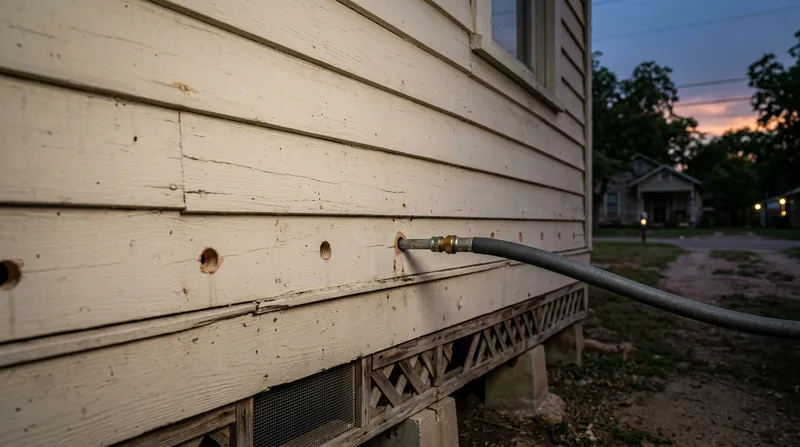




Wall & Injection Foam Insulation in Waco fills the closed wall cavities of older pier-and-beam homes that dominate the neighborhoods near downtown and around Baylor University. These houses, built on raised foundations with thin wood-frame walls, sit directly in the path of humid air movement that runs through wall cavities from outside to in. Small drilled holes between studs let low-pressure foam expand and seal those cavities, blocking the humid air that drives moisture into living spaces and drives cooling bills higher every summer. The blackland clay soils around Waco shift with wet and dry cycles, stressing the band joists and rim boards that sit at the foundation line, and wall injection foam addresses that same moisture boundary. For rental housing near campus and older single-family homes across Bellmead, Lacy-Lakeview, and Robinson, injection foam is the only retrofit method that reaches inside closed walls without demolition. We have been doing this work since 2011, and we measure every job with R-value and thickness specs so you know exactly what you are getting.
Why Wall Injection Foam Matters in Waco's Older Housing Stock
Waco's pier-and-beam homes sit on raised foundations with vented crawl spaces below and thin exterior walls that face the Brazos River humidity year-round. During summer, humid outside air moves through wall cavities, condensing on cooler interior surfaces and driving moisture into framing, insulation, and drywall. Injection foam stops that air movement at the source, sealing cavities that fiberglass batts cannot reach once walls are closed. The alternative, which some homeowners consider, is to tear open walls, remove old insulation, install new batts, and close everything back up. Injection foam does the same job without the demolition, the drywall repair, or the weeks of disruption.
- Injection foam reaches cavities that are already enclosed and cannot be accessed from inside.
- The foam expands to fill voids completely, blocking both air leakage and moisture movement.
- Drilling holes between studs leaves no visible damage once small holes are sealed.
- Older homes near campus often have settled unevenly, creating air gaps that hand-packing insulation cannot close.
- Humid air moving through walls in summer is the leading cause of moisture damage in Waco's pre-1960 housing stock.
Stopping humid air before it enters walls is the most cost-effective way to protect framing and extend the life of the house.
Key info: A typical pier-and-beam rental near Baylor or a 1950s ranch home in Bellmead will have 2x4 or 2x6 exterior walls with 3.5 to 5.5 inches of cavity depth. Injection foam fills that space completely, creating an air barrier that fiberglass alone cannot match. See the Texas Department of Licensing and Regulation for contractor registration requirements in your city: https://www.tdlr.texas.gov/
How Wall Injection Foam Installation Works in Waco Homes
We start with a visual inspection of the wall to identify stud locations, electrical outlets, and any existing damage. Small holes (typically 1 to 1.5 inches in diameter) are drilled between studs at intervals of 16 to 24 inches, depending on wall height and cavity width. Low-pressure injection equipment fills each cavity from bottom to top, allowing the foam to expand and conform to the exact shape of the space. Once the foam has cured (typically 24 to 48 hours), we seal all holes with foam-compatible plugs or patch material that blends with your exterior finish. The entire process requires mechanical ventilation during application and a posted re-entry window that we provide in writing.
- We locate studs and utilities using non-invasive scanning before drilling any holes.
- Holes are drilled at the correct spacing to ensure complete cavity fill without over-packing.
- Low-pressure injection equipment applies foam at controlled flow rates, preventing structural stress.
- We monitor foam density and cure time according to manufacturer specifications and local code.
- All holes are sealed with matching material so the exterior finish looks complete when we leave.
The job is complete once the foam has cured fully and the exterior finish is restored.
Example: A 1,200-square-foot rental house in Waco with four exterior walls and 8-foot ceilings has roughly 3,840 linear feet of wall cavity. Injection foam at typical 3.5-inch depth fills that cavity in a single day of drilling and injecting, with cure time extending into the next day. The homeowner or property manager can re-occupy after 48 hours. Compare that to the cost and timeline of opening walls, replacing insulation, and patching drywall, and the value is clear. See our full pricing overview for comparable costs on attic and crawl space work.
Wall Injection Foam Methods and Approaches
| Method | Description | Best For |
|---|---|---|
| Low-Pressure Injection (Open Cell) | Foam expands at 1 to 3 pounds per cubic foot, filling cavities without structural stress. Good sound dampening. Allows some moisture vapor to move through the foam. | Interior walls and older homes where air sealing is the priority and cavity depth is standard 3.5 inches. |
| Medium-Pressure Injection (Closed Cell) | Foam expands at 2 to 3 pounds per cubic foot with higher R-value per inch. Stops both air and moisture vapor movement. Requires careful monitoring to avoid overpressure. | Exterior walls in humid climates, band joists, and rim board cavities where moisture control is critical. |
| Partial Fill with Top-Up Insulation | Injection foam fills the lower half or two-thirds of the cavity, then blown-in cellulose or fiberglass tops it off to full depth. Reduces material cost while maintaining air barrier at the critical moisture boundary. | Tall cavities (5.5 inches or deeper) and budget-conscious retrofits where air sealing at the foundation line is the primary goal. |
| Injection Without Demolition (Retrofit Standard) | Existing walls remain intact. Small holes drilled from exterior or interior, foam injected, holes sealed. No drywall removal, no interior finishes disturbed. | All retrofit scenarios in Waco, especially rental properties and occupied homes where interior access or demolition is not an option. |
Each method is chosen based on cavity depth, wall orientation, moisture risk, and your budget. We measure the cavity and propose the approach that gives you the best R-value and air sealing per dollar spent.
Wall & Injection Foam Insulation Cost in Waco: What to Expect
Wall injection foam in Waco typically starts at $2.00 to $3.50 per square foot of wall area, depending on cavity depth, foam type (open or closed cell), and the number of holes required. A 1,000-square-foot wall section with standard 3.5-inch cavities and open-cell foam will run $2,000 to $3,500 before any patching or finish work. Closed-cell foam costs more per square foot but delivers higher R-value and superior moisture control, so it is the better choice for exterior walls and foundation-line cavities in Waco's humid climate. Additional costs include drilling access holes (typically $50 to $150 per wall depending on layout), sealing and patching holes ($200 to $500 for the exterior finish), and any necessary removal of old, wet, or contaminated insulation before injection begins.
The single biggest factor that moves cost up or down is whether the wall is accessible from outside or inside. Exterior drilling from a ladder or scaffolding takes longer than interior drilling and costs more. Foundation-line band joists and rim boards, which sit below the main wall cavity, often require separate injection and cost an additional $500 to $1,500 depending on the length of the band. Getting two or three written estimates from different contractors is the only way to verify pricing for your specific house and wall layout. We provide free written estimates with R-value and thickness specs, so you can compare apples to apples.
Cost breakdown example: A 1,200-square-foot pier-and-beam rental in Bellmead with four exterior walls (roughly 3,200 sq ft of wall cavity at standard depth) will cost $6,400 to $11,200 for full-wall injection foam using open-cell foam, plus $800 to $1,500 for hole sealing and exterior patching. Closed-cell foam on the same house runs $8,000 to $14,000 total. If old wet fiberglass must be removed first, add $1,000 to $2,000. See our detailed pricing page for breakdowns by service type and region.
What to Look for When Hiring a Spray Foam Contractor Near Me in Waco
Hiring the right spray foam contractor is the difference between a job that solves your moisture and air-leakage problem and one that leaves you with a chemical smell, incomplete coverage, or warranty claims you cannot verify. Start by asking any contractor for their insurance certificate and verifying coverage limits directly with their insurance company. Check contractor registration with your city or county before work begins, because registration requirements vary across Greater Waco and there is no reciprocity between cities. Ask for a written estimate that includes R-value per inch, foam thickness, and the square footage being treated, so you can compare proposals side by side. Never accept a price quote without those specifications, and never accept an estimate that promises re-entry before 24 to 48 hours have passed.
- Request references from at least two completed jobs in Waco or nearby cities and call them to ask about cure time, smell, and whether the work held up.
- Confirm that the contractor carries a mechanical ventilation system for use during application and that they provide a posted re-entry window in writing.
- Ask whether the contractor is familiar with your city's permitting process and whether a permit is required for interior wall injection at your address.
- Get a written scope of work that lists which walls are being injected, hole locations, foam type, and the timeline from drilling through cure.
- Verify that the contractor's insurance is active and current, and that their liability coverage includes spray foam application.
The cheapest estimate is rarely the best value. A contractor who quotes half the market rate, promises immediate re-entry, and cannot provide insurance verification is the clearest marker of rig-and-run work. Call us at (254) 218-4354 for a free estimate and to ask any questions about how we work and what to expect on your property.
Wall & Injection Foam Insulation in Waco: Pricing Guide
| Service | Price | Details |
|---|---|---|
| Open-Cell Injection Foam | Starting at $2.00/sq ft | Wall cavity fill for standard 3.5-inch depth, includes drilling, injection, and foam cure. Price varies with cavity accessibility and wall orientation. |
| Closed-Cell Injection Foam | Starting at $3.00/sq ft | Higher R-value per inch and complete moisture vapor barrier for exterior walls and foundation-line cavities. Better for humid climates and band joists. |
| Hole Sealing and Exterior Patching | Starting at $200 | Sealing all access holes and matching exterior finish. Cost depends on wall material, number of holes, and paint or siding repair needed. |
| Existing Insulation Removal (if needed) | Starting at $1,000 | Removal of old wet, moldy, or contaminated fiberglass or cellulose before injection foam is applied. Disposal and haul-away included. |
| Band Joist and Rim Board Injection | Starting at $500 | Separate injection of foundation-line cavities, typically closed-cell foam for moisture control. Cost scales with linear feet of band joist perimeter. |
| Free Written Estimate | No charge | Includes R-value, thickness, square footage, and timeline. Response within 24 hours at (254) 218-4354, no obligation to book. |
Indicative pricing, the exact cost depends on square footage, finish, and site access. Free personalized estimate within 24h at (254) 218-4354.


