Understanding Slab-on-Grade Construction in Waco's Blackland Region
If you own a ranch-style home in Waco, chances are your house sits directly on a concrete slab foundation rather than a traditional crawl space or basement. This construction method became popular throughout Central Texas because it's economical and works reasonably well in our region. However, Waco's Blackland clay soil presents unique challenges that many homeowners don't fully appreciate until they start experiencing energy efficiency problems.
Blackland clay is expansive soil, meaning it swells when wet and shrinks when dry. This constant movement can stress your home's foundation and, more importantly for insulation purposes, create gaps and air leaks around the perimeter where your slab meets the walls. Traditional insulation methods like blown in insulation and fiberglass batts simply cannot seal these gaps effectively, leaving your conditioned air to escape and outdoor air to infiltrate your living spaces. The result is higher utility bills, inconsistent room temperatures, and unnecessary strain on your HVAC system year-round.
Spray Foam vs. Blown In Insulation: Why Spray Foam Wins for Slab Homes
When comparing spray foam vs blown in insulation, the differences become especially clear when you're dealing with a slab-on-grade home. Blown in insulation, whether cellulose or fiberglass, relies on gravity and settling to fill cavities. It works reasonably well in attics where you have a flat, open space to work with. However, blown in insulation cannot effectively seal the irregular gaps, cracks, and transitions that occur where your slab meets the rim joist and exterior walls. These gaps are where energy loss happens in slab homes, and blown in insulation simply slides past them without creating an air-tight seal.
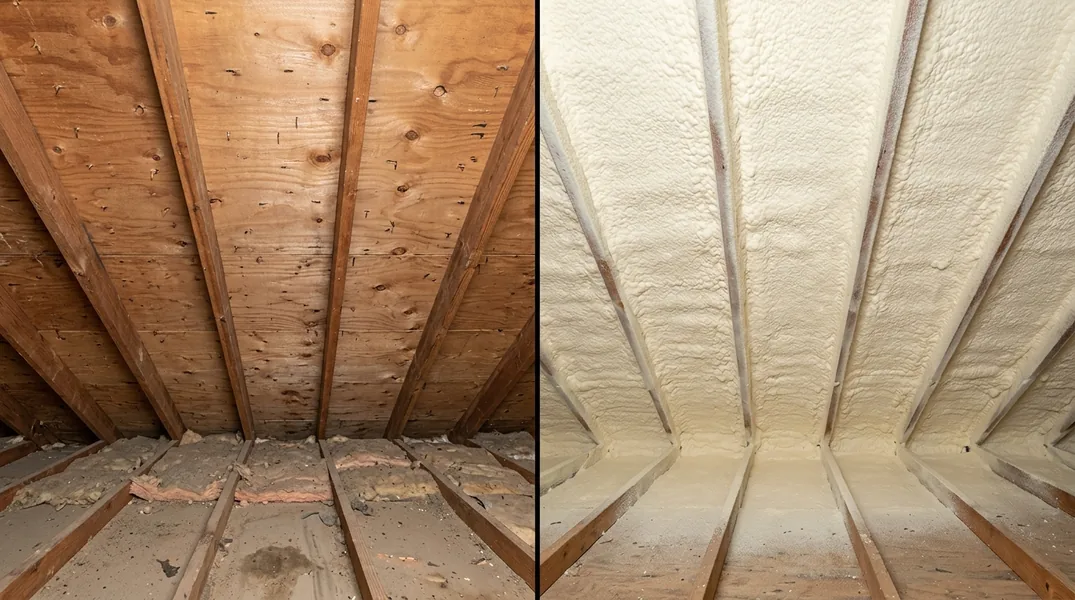
Attic Spray Foam Insulation and other spray foam applications expand as they cure, conforming perfectly to every crack, crevice, and irregular surface. When a professional applies spray foam around your slab perimeter and rim joist areas, it expands to fill every void and hardens into a continuous, air-tight barrier. This not only provides superior insulation value but also acts as an air seal that prevents the infiltration and exfiltration that plague slab homes in Waco. For homeowners serious about energy efficiency, this difference is transformative.
Spray Foam vs. Fiberglass: The Case for Modern Insulation Technology
The spray foam vs fiberglass debate has evolved significantly over the past decade as spray foam technology has matured and become more accessible to homeowners. Fiberglass batts have been the standard for decades, and they remain affordable. However, fiberglass has inherent limitations that spray foam simply doesn't share. Fiberglass works by trapping air in its fibers, which means it only insulates if it maintains its integrity and maintains contact with the framing. Any compression, moisture, or air gaps around the batts dramatically reduce its effectiveness.
In slab-on-grade homes, fiberglass insulation cannot adapt to the settling and shifting that occurs as Blackland clay expands and contracts. Over time, gaps form between the batts and the framing, compromising your thermal envelope. Spray foam, by contrast, remains flexible yet durable, and its continuous seal prevents air movement entirely. Additionally, fiberglass absorbs moisture, which can lead to mold growth and degradation in humid climates like Central Texas. Spray foam, particularly Closed Cell Spray Foam Insulation, is moisture-resistant and actually provides a vapor barrier that protects your home's structure from moisture intrusion.
Spray Foam vs. Cellulose: Durability and Performance in Texas Climates
Cellulose is often marketed as an eco-friendly alternative to fiberglass, and while it does contain recycled content, it carries significant drawbacks for homes built on clay slab foundations. Cellulose is highly hygroscopic, meaning it readily absorbs moisture from the air. In Waco's humid summers, cellulose insulation can absorb moisture and lose its insulating properties. It also settles over time, creating voids that reduce its R-value. Perhaps most concerning for slab homes, cellulose cannot seal air gaps, and it's susceptible to pest damage and mold growth in damp conditions.
When you compare spray foam vs cellulose, spray foam's performance advantage is undeniable for long-term durability and moisture resistance. Spray foam does not absorb moisture, does not settle, and does not degrade over decades of use. For homeowners in Waco who want an insulation solution that will protect their investment for 20, 30, or 40 years without degradation, spray foam is the clear choice. The slightly higher upfront cost is offset by lower energy bills, better comfort, and the elimination of future moisture and pest problems that cellulose invites.
Best Insulation for Attic and Slab Areas: A Comprehensive Approach
When discussing the best insulation for attic spaces in slab-on-grade homes, it's important to recognize that your entire thermal envelope needs attention. While your attic insulation is crucial, the slab perimeter and rim joist areas are equally important for energy efficiency in these homes. Many homeowners focus exclusively on attic insulation and overlook the fact that 20-30% of their energy loss comes from uninsulated or poorly insulated slab edges and walls. A comprehensive insulation strategy addresses both areas with appropriate materials.
For attic spaces, Open Cell Spray Foam Insulation or blown in cellulose can work well if properly installed. However, for slab perimeters, rim joists, and band board areas, spray foam is the superior choice because it seals air leaks while providing insulation. Professional contractors often recommend a hybrid approach: spray foam for critical air-sealing areas like slab edges and rim joists, combined with blown in or fiberglass in attic cavities where air sealing is less critical. This balanced strategy gives you the best performance at a reasonable cost. If you're unsure which approach makes sense for your specific home, contacting Waco Spray Foam Insulation for a free estimate will provide clarity on the most cost-effective solution for your property.
Spray Foam Insulation Cost in Waco: What to Budget for Slab Home Upgrades
Homeowners naturally want to understand the financial investment required for spray foam insulation. The pricing for spray foam varies based on the scope of your project, the type of spray foam used, and the accessibility of the areas being insulated. For slab-on-grade homes in Waco, a typical project might involve insulating the rim joist, band board, and slab edge, which usually costs between $1,500 and $4,000 depending on the linear footage of your home's perimeter and the R-value desired. If you're also upgrading attic insulation or considering Wall & Injection Foam Insulation for existing walls, the investment increases accordingly.
While spray foam costs more per square foot than blown in insulation or fiberglass, the return on investment is compelling. Homeowners typically see 15-30% reductions in heating and cooling costs, which translates to savings of $30-80 per month for many households. Over a 10-year period, these savings easily exceed the initial installation cost, and you'll enjoy improved comfort and better indoor air quality throughout that time. Additionally, spray foam adds value to your home and can improve its resale appeal to energy-conscious buyers. To get an accurate quote tailored to your home's specific needs, call Waco Spray Foam Insulation at (254) 218-4354 or request a free estimate online. Our team will assess your slab foundation, evaluate your current insulation, and provide a detailed proposal with transparent pricing.
Looking for a professional spray foam insulation contractor in Waco? Waco Spray Foam Insulation responds fast for all your spray foam insulation needs.
Get a Free Quote